← Cat encyclopedia06
61 GUIDES
Indoor cats & enrichment
Make home safer, richer and more interesting every day.
IN THIS LIBRARY
Indoor cat enrichment and wellbeing
Indoor life can be safe and satisfying when cats can climb, scratch, hunt, hide, observe and make choices. This hub turns ordinary rooms into a richer environment without requiring expensive equipment.
CHOOSE TODAY’S PROJECT
Six practical ways to enrich indoor life
Pick one realistic improvement. Watch how your cat responds, then keep, simplify or change it.
BUILD A RICHER HOMESimple enrichment for indoor cats
The essential mix of choice, movement, hunting and rest
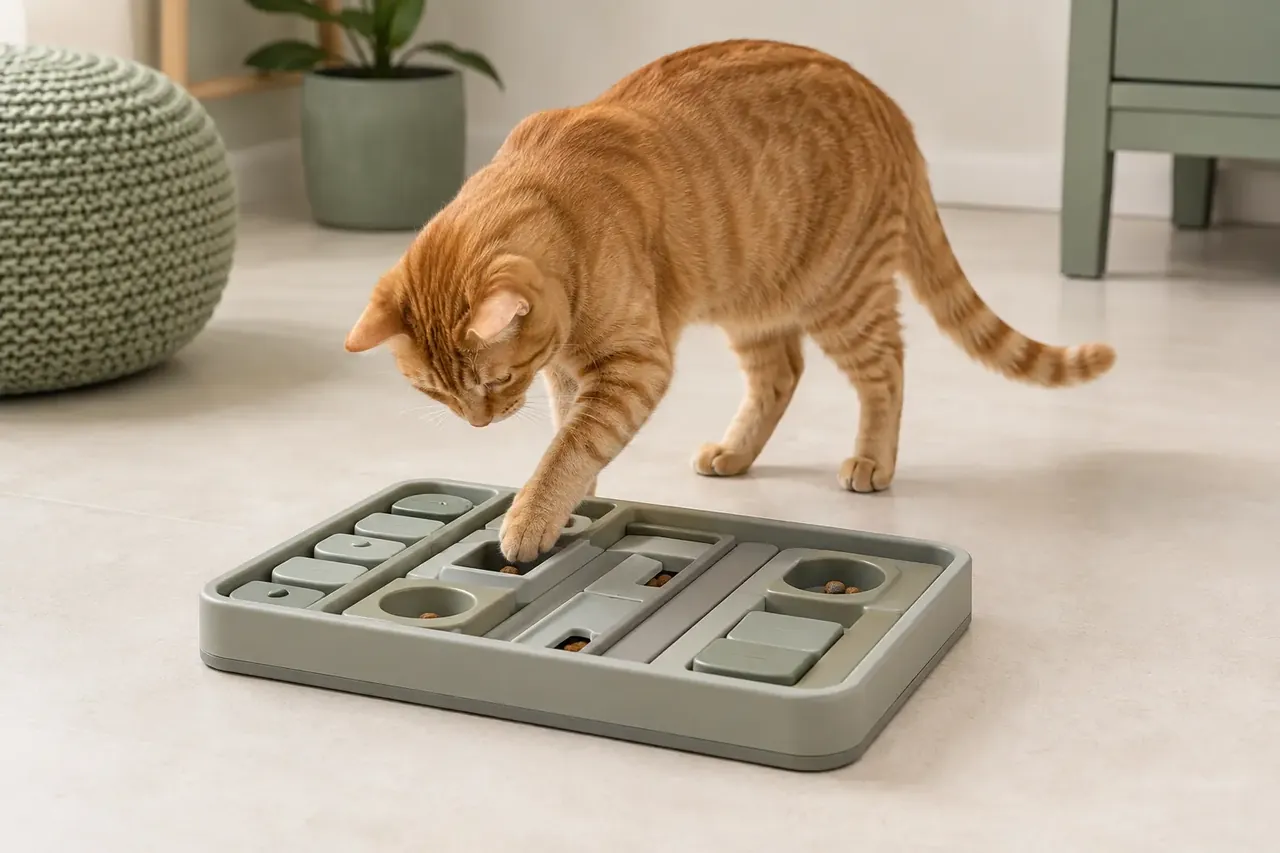
Try this enrichment idea →FOOD PUZZLESA beginner’s guide to puzzle feedersStart easy and turn part of a meal into a search
Try this enrichment idea →TOY ROTATIONRotate cat toys without buying moreKeep familiar toys interesting without buying more
Try this enrichment idea →SCRATCHINGWhy some cats prefer horizontal scratchersMatch the surface and position your cat already chooses
Try this enrichment idea →START WITH YOUR QUESTION
What this topic covers
Offer different kinds of choice
Combine high and low resting places, open and enclosed beds, vertical and horizontal scratching, and more than one route through important rooms.
Make play resemble prey
Move toys away, hide them, pause and allow a catch. Several short sessions often work better than leaving every toy on the floor.
Prevent quiet resource competition
Separate food, water, litter, beds and heights so one cat cannot control every valuable location. Conflict can exist without obvious fighting.
QUICK QUESTIONS
Important answers before you browse
Do indoor cats get bored?+
They can when opportunities stay predictable or limited. Rotation, choice, play and environmental complexity help meet behavioral needs.
How often should I play with my cat?+
Individual needs vary. Several brief sessions matched to the cat’s age, health and interest are a useful starting point.
GOOD PLACE TO START · 8 min
Why does my cat prefer cardboard scratchers?
Cardboard offers a satisfying texture, visible marks and a stable horizontal option for many cats..
Read the guide →POPULAR IN THIS LIBRARY
See the complete library ↓Useful answers to start with
01 · 8 minWhy does my cat prefer cardboard scratchers?Read guide →02 · 8 minWhy does my cat ignore expensive toys?Read guide →03 · 8 minWhy does my cat chew cardboard boxes?Read guide →04 · 8 minHow can a hallway become cat enrichment?Read guide →05 · 8 minCan watching birds frustrate a cat?Read guide →06 · 9 minWhy does my cat hide toys under a blanket?Read guide →
All indoor cats & enrichment guides
61 articles01
GUIDE · 8 min
→02Why does my cat prefer cardboard scratchers?
Cardboard offers a satisfying texture, visible marks and a stable horizontal option for many cats..
GUIDE · 8 min
→03Why does my cat ignore expensive toys?
Price does not predict whether movement, texture, size and sound match an individual cat’s hunting preferences..
GUIDE · 8 min
→04Why does my cat chew cardboard boxes?
Texture, play, investigation and stress relief can all contribute, but swallowing pieces is unsafe..
GUIDE · 8 min
→05How can a hallway become cat enrichment?
A narrow route can support short chases, scent trails and movement between safe stations..
GUIDE · 8 min
→06Can watching birds frustrate a cat?
Most cats enjoy observing, but some remain highly aroused when they can never complete a hunting sequence..
GUIDE · 9 min
→07Why does my cat hide toys under a blanket?
Burying a toy under a blanket can extend hunting play or create a preferred hiding challenge. It is safe only when fabric and toy parts cannot be swallowed.
GUIDE · 9 min
→08Why Does My Cat Put Toys in My Shoes?
Shoes combine strong familiar scent with a small container where objects can be stored. Learn what to observe, what to try safely and when to seek help.
GUIDE · 9 min
→09Why Does My Cat Prefer an Old Box to a New Bed?
A familiar box offers known scent, firm edges and protection, while a new bed may smell unfamiliar. Learn what to observe, what to try safely and when to seek help.
GUIDE · 9 min
→10How far and high can a cat safely jump?
Ability varies with age, conditioning, footing, confidence and health. A calm, practical guide to what it means and what to do next.
GUIDE · 9 min
→11Why Does My Cat Ignore New Toys?
Movement, texture, scent and timing must match the individual cat's play preferences. Learn what to observe, what to try safely and when to seek help.
GUIDE · 9 min
→12Why cats often scratch after waking
Scratching after waking is a normal stretch, claw-maintenance and scent-marking routine. Put a stable scratcher beside the sleeping area rather than trying to stop it.
GUIDE · 9 min
→13Why some cats prefer horizontal scratchers
Body angle, material and stability determine whether a scratching surface feels satisfying. A calm, practical guide to what it means and what to do next.
GUIDE · 9 min
→14How close should a cat tree be to a window?
A cat tree should be close enough for a useful view but far enough from glass, cords and weak screens to prevent falls, entrapment and overheating.
GUIDE · 9 min
→15How to space wall shelves for a cat
Cat shelves need short achievable gaps, generous landing surfaces and a route down as well as up. Spacing should suit the individual cat, not an ideal athlete.
GUIDE · 9 min
→16How to stop a cat climbing curtains
Curtain climbing is usually an access and enrichment problem, not spite. Prevent falls and provide a safer legal route upward.
GUIDE · 9 min
→17How to test whether a scratching post is stable enough
A scratcher that rocks, tips or slides will often be rejected. It should stay still during a full-body pull from the cat's highest comfortable reach.
GUIDE · 9 min
→18How to design escape routes in a cat-friendly room
Every important cat area needs more than one way out so a person, dog or other cat cannot quietly trap access to food, litter, rest or height.
GUIDE · 8 min
→19Why does my cat lose interest in a wand toy?
Cats often lose interest when a wand toy becomes predictable, moves toward them or never allows a catch. Short prey-like sessions with hiding, pauses and success usually work better than faster waving.
GUIDE · 8 min
→20Why does my cat prefer the box to the toy?
A cardboard box often beats a toy because it provides hiding, texture, scent, warmth and control at the same time. That preference is useful information about what makes play feel safe.
GUIDE · 8 min
→21How long should you play with a cat?
Most cats benefit from several short, satisfying play sessions rather than one exhausting workout. Start with five to ten minutes, then follow your cat's engagement, fitness and recovery.
GUIDE · 8 min
→22How often should cat toys be rotated?
Rotate a small selection of safe cat toys every few days while leaving favourite comfort toys available. Novelty works best when the play style changes too, not only the object.
GUIDE · 8 min
→23Why does my cat watch a toy but refuse to chase it?
Watching a toy is part of hunting, not failed play. The cat may be calculating distance or waiting for slower, quieter prey movement and better cover before joining.
GUIDE · 8 min
→24How to make an open-plan home feel safe for a cat
An open-plan room feels safer when a cat can cross it using edges, height, cover and more than one route. Break exposed space into connected zones instead of placing every resource around the walls at random.
GUIDE · 8 min
→25How to map resources in a multi-cat home
Map a multi-cat home by access, not just item count. Bowls or trays placed together can act like one resource when a cat can watch or block the whole area.
GUIDE · 9 min
→26Why Does My Cat Splash the Water Bowl at Night?
Movement, reflections, boredom or testing the water surface can turn drinking into play during active hours.
GUIDE · 8 min
→27Why does my cat wake me at the same time every morning?
A predictable cat morning routine can reduce door-meowing and food demands: brief check-in, play or movement, measured breakfast, litter care and quiet independent activity.
GUIDE · 8 min
→28How to prepare a cat for a workday alone
Most healthy adult cats can manage a normal workday when food, water, clean litter, safe resting choices and enrichment are prepared before you leave.
GUIDE · 8 min
→29Do cats need the same routine at weekends?
Cats cope best when weekend meals, medication and essential care stay close to the weekday pattern, even if play and family time become more flexible.
GUIDE · 8 min
→30What a pet camera can—and cannot—tell you about your cat
A home camera can reveal eating, resting and social pressure, but place it only in ordinary shared cat areas and use recordings to observe patterns—not to provoke reactions.
GUIDE · 8 min
→Preparing your cat for houseguests
Help a cat cope with houseguests by protecting one guest-free safe room, keeping resources stable and asking visitors to let the cat choose contact.
COMPLETE LIBRARYShow 31 more indoor cats & enrichment guidesOpen +
31
GUIDE · 8 min
→32Why won’t my cat use a new cat bed?
A new bed may smell unfamiliar, feel unstable or sit in the wrong location. Cats choose beds by safety, temperature and texture—not price.
GUIDE · 8 min
→33Is it safe to let a cat pounce on hands under a blanket?
Movement under blankets can trigger prey play, but hands and feet should not become toys because bites and scratches can escalate.
GUIDE · 8 min
→34Why does my cat drop toys in the water bowl?
Dropping toys in water may be playful carrying, storage or simple accident. The priority is keeping the water clean and preventing toy material from being swallowed.
GUIDE · 8 min
→35Why does my cat only want to play at night?
Cats are naturally active around dawn and dusk, and a cat may save play for night when the home is quiet. A planned evening routine can shift some activity earlier.
GUIDE · 8 min
→36Why is my cat afraid of an electronic toy?
A cat may fear an electronic toy because of its motor noise, unpredictable movement or flashing lights. Build confidence at the cat's pace instead of moving the toy closer.
GUIDE · 8 min
→37How can you tell if a cat puzzle feeder is too difficult?
A puzzle is too difficult when the cat repeatedly works without receiving food, becomes frustrated or walks away before eating enough.
GUIDE · 8 min
→38Why won’t my cat use a wobbly scratching post?
A wobbling scratching post may be avoided or can fall and injure a cat. Stability, height and texture matter more than decoration.
GUIDE · 8 min
→39Why a cat may stop using the litter box
A cat toileting outside the box is communicating a problem, not taking revenge. Sudden changes need a veterinary check while you improve access, cleanliness and safety.
GUIDE · 7 min
→40Why a cat bites during petting
Petting bites are often preceded by small signs of rising arousal. Shorter contact, frequent pauses and letting the cat choose can prevent many incidents.
guide · 8 min
→41A realistic play routine for busy cat owners
Three short daily hunts can be more useful than one exhausting session.
guide · 8 min
→42Quiet bullying in multi-cat homes
Blocking, staring and resource control can matter even without fights.
GUIDE · 8 min
→43How to introduce two cats slowly
A good cat introduction begins with complete separation, then scent, closed-door routines and brief visual contact. Progress depends on relaxed behaviour, not a deadline.
GUIDE · 6 min
→44How much sleep do cats need?
Many cats rest for much of the day in a mix of naps and light dozing. The meaningful question is whether sleep, waking, appetite, movement or interaction has changed from that cat’s normal pattern.
guide · 8 min
→45Helping cats through fireworks and thunderstorms
Prepare early, reduce escape risk and let hiding work.
GUIDE · 5 min
→46The science of cat zoomies
Brief cat zoomies are usually normal bursts of sprinting after rest, play or litter-box use. Make the route safe and use daily hunt-style play; investigate episodes that include distress, pain or disorientation.
guide · 8 min
→47Teach a cat that the vacuum predicts safety
A gradual plan that never requires trapping the cat near the machine.
guide · 8 min
→48Prevent door-dashing without frightening your cat
Use stations, barriers and rewards to protect the doorway.
guide · 6 min
→49Build better indoor territory
A good indoor home offers height, hiding, scratching and separated resources.
guide · 8 min
→50Protect furniture by improving the scratching offer
Match location, angle and material instead of fighting a normal behaviour.
guide · 6 min
→51Safe window watching
A secure view can add scent, movement and daily novelty.
guide · 6 min
→52Puzzle feeders from easy to expert
Difficulty should grow only after the cat succeeds confidently.
guide · 6 min
→53The five-minute play plan
A five-minute play session can provide a complete small hunting sequence: notice, stalk, chase, catch and settle. Quality and predictability matter more than exhausting the cat.
guide · 6 min
→54Catio basics
A secure outdoor enclosure can offer weather, scent and observation safely.
guide · 8 min
→55Helping a shy cat when guests visit
Give the cat control before the doorbell turns into a crisis.
GUIDE · 7 min
→56Why cats hide—and when to worry
Hiding is a normal safety and rest behaviour, but new or prolonged hiding can be an early sign of pain, fear or illness. Compare appetite, litter use, movement and social contact with the cat’s baseline.
GUIDE · 5 min
→57Why cats meow at closed doors
Closed-door meowing can reflect lost access, social contact, learned results or an unmet need. Check wellbeing first, then use one consistent rule and reward calm behaviour away from the door.
GUIDE · 7 min
→58A beginner’s guide to puzzle feeders
A good cat puzzle feeder begins easy, uses part of the measured daily food and lets the cat succeed quickly. Increase difficulty only while the cat stays engaged rather than frustrated.
guide · 6 min
→59Feed multiple cats without quiet competition
Separate feeding stations help every cat eat without being watched, rushed or blocked.
guide · 6 min
→60Rotate cat toys without buying more
A small toy rotation can make familiar playthings feel interesting again.
GUIDE · 5 min
→61Why cats chatter at birds
Cats often chatter when intensely watching birds or other prey through a secure window. It usually reflects hunting focus and arousal, not frustration that needs punishment or outdoor access.
GUIDE · 5 min
→Why cats love cardboard boxes
Cardboard boxes combine cover, warmth, novelty and choice, which is why many cats prefer them to expensive beds. Remove tape, staples and handles, and replace damaged or damp boxes.