Why cats meow at closed doors
Closed-door meowing can reflect lost access, social contact, learned results or an unmet need. Check wellbeing first, then use one consistent rule and reward calm behaviour away from the door.
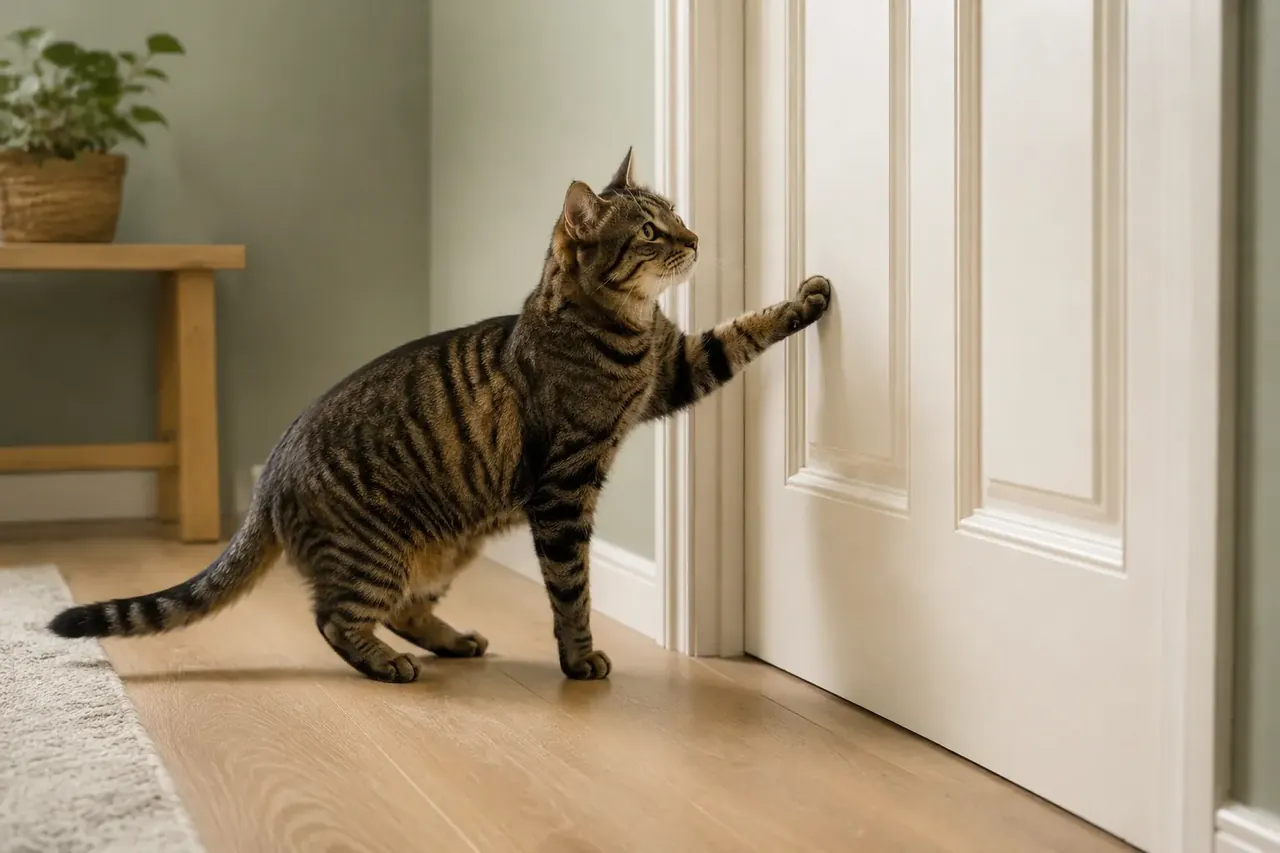 Topic illustration selected for this guide. Some learning images may be AI-assisted.
Why cats meow at closed doors — the quick answer
✓ Closed doors change access to familiar space
✓ Repeated responses can strengthen the habit
✓ Check needs before ignoring the request
A closed door changes your cat's access to familiar territory. The objection may be about curiosity, routine or wanting to be near someone on the other side.
Access matters
Cats keep track of routes, rooms and household activity. A barrier can become interesting even when the room itself is ordinary.
Responses teach patterns
If meowing always opens the door, the cat learns that persistence works. Choose a consistent household rule after checking food, water, litter and wellbeing.
Offer an alternative
Create an appealing nearby perch, short play session or resting place when a room must remain closed.
Find the trigger before changing the response
Note which door, time and person are involved and what happened immediately before the meowing. Confirm that food, water, litter, play, temperature and access to the household are adequate. New persistent vocalising deserves a health check.
Teach an alternative location
Create a mat, bed or perch a short distance from the door. Reward quiet settling there and open the door during calm moments when access is allowed. Do not frighten, spray or shout; that can add stress without explaining the boundary.
Your quick checklist
Your progress is saved on this device.
Three simple things you can do
You do not have to change everything today. Pick one step that feels realistic, try it and see how your cat responds.
- 1Check food, water, litter, comfort and whether someone is accidentally shut away before responding.
- 2Choose a consistent household rule for rooms that must remain closed.
- 3Offer a nearby perch, hiding place or short play opportunity before the usual door protest begins.
Common mistakes
×Opening the door only after a long period of loud meowing and teaching persistence.
×Punishing the cat for objecting to lost access.
×Ignoring a new pattern accompanied by distress, confusion or other health changes.
Questions cat people ask
Why does my cat want a door opened and then walk away?+
Access itself can matter because cats monitor routes, territory and household activity. The room may be less important than having the option.
Should I ignore meowing at a closed door?+
First check genuine needs and safety. If the door must stay closed, use a predictable rule and reinforce calm alternatives rather than sometimes opening it after prolonged calling.
Still looking for the right answer?
Search the full EverYes Cats encyclopedia with your own words — a symptom, food, behaviour, breed or everyday question.
Checked, dated and transparent
- Prepared by
- EverYes Cats editorial team
- Last updated
- 13 August 2026
- Source checked
- 13 August 2026
- Primary reference
- FelineVMA Healthy Feline Environment ↗
We begin with the named reference, rewrite the information in plain language and add practical cat-parent steps. Urgent health statements are checked against veterinary sources. This guide has not been individually reviewed by a veterinarian unless explicitly stated. It provides education, not diagnosis or treatment.
Spotted something unclear or outdated? Tell us so we can review it.
Your answer helps us improve the cat encyclopedia.
Brief cat zoomies are usually normal bursts of sprinting after rest, play or litter-box use. Make the route safe and use daily hunt-style play; investigate episodes that include distress, pain or disorientation.