How to introduce two cats slowly
A good cat introduction begins with complete separation, then scent, closed-door routines and brief visual contact. Progress depends on relaxed behaviour, not a deadline.
 Topic illustration selected for this guide. Some learning images may be AI-assisted.
How to introduce two cats slowly — the quick answer
✓ Begin with separate spaces and resources
✓ Exchange scent before face-to-face meetings
✓ Move back a step if either cat remains distressed
Successful introductions are usually gradual. The goal is not instant friendship, but repeated experiences in which both cats feel safe.
Introduce cats without rushing the distance
Progress means both cats can remain comfortable, not that they must meet quickly.
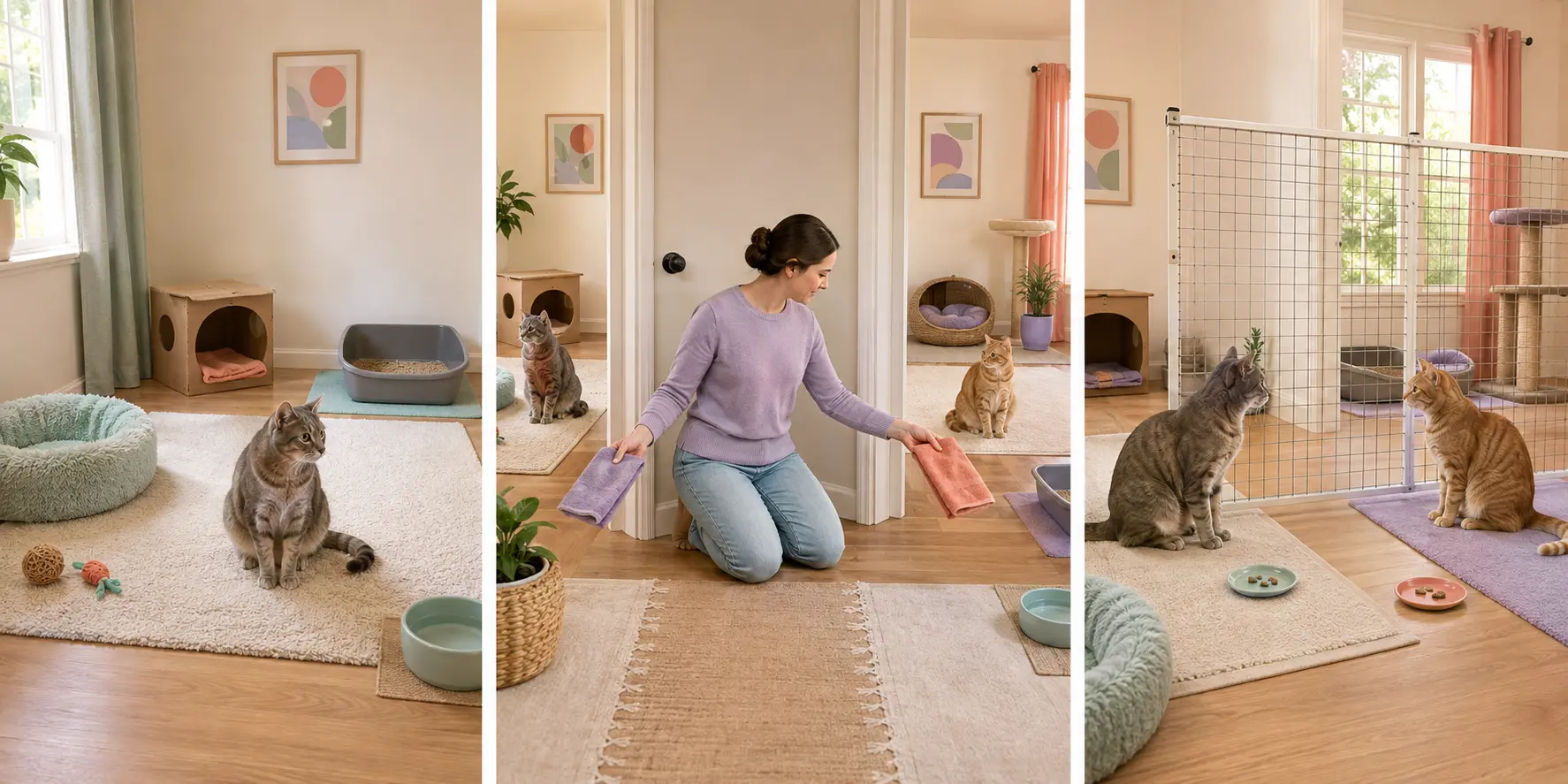
- 1Begin separately
Give the newcomer a complete safe room with food, water, litter, rest and hiding choices.
- 2Exchange familiar scent
Swap bedding or scent cloths and pair the other cat's scent with calm routines and food.
- 3Use a secure barrier
Begin brief visual contact through a barrier and increase time only while both cats cope well.
Start separately
Give the newcomer a quiet room with food, water, litter, hiding places and comfortable resting areas.
Build familiarity
Swap bedding or use a soft cloth to transfer scent. Feed on opposite sides of a closed door at a distance each cat accepts.
Keep meetings short
Use a secure barrier for early visual contact. End while both cats are still coping, and avoid forcing them close together.
Prepare two complete territories
The newcomer needs a secure room with food, water, litter, hiding, scratching and height. The resident cat keeps access to familiar resources. In the wider home, provide multiple separated feeding, water, sleeping and litter locations so neither cat must pass the other to meet a basic need.
Move forward only when both cats can cope
Begin with scent exchange and positive routines on opposite sides of a closed door. Later use a secure visual barrier at a distance. A hiss is information, not failure, but fixed staring, stalking, lunging, food refusal or inability to settle means increase distance and return to an easier stage.
Your quick checklist
Your progress is saved on this device.
Three simple things you can do
You do not have to change everything today. Pick one step that feels realistic, try it and see how your cat responds.
- 1Create complete separate resource areas before arrival.
- 2Exchange bedding after both cats are relaxed in their own spaces.
- 3Keep first visual sessions short and separated by a secure barrier.
Common mistakes
×Placing the cats together to let them work it out.
×Moving forward while either cat remains highly aroused.
×Expecting them to share one litter box, bowl or resting place.
Questions cat people ask
How long does an introduction take?+
It can take days, weeks or longer. Progress should be based on relaxed behavior, not a calendar target.
Does hissing mean the introduction has failed?+
No. Hissing communicates discomfort and a need for space. Increase distance and return to an easier step.
Still looking for the right answer?
Search the full EverYes Cats encyclopedia with your own words — a symptom, food, behaviour, breed or everyday question.
Checked, dated and transparent
- Prepared by
- EverYes Cats editorial team
- Last updated
- 8 August 2026
- Source checked
- 8 August 2026
- Primary reference
- FelineVMA Healthy Feline Environment ↗
We begin with the named reference, rewrite the information in plain language and add practical cat-parent steps. Urgent health statements are checked against veterinary sources. This guide has not been individually reviewed by a veterinarian unless explicitly stated. It provides education, not diagnosis or treatment.
Spotted something unclear or outdated? Tell us so we can review it.
Your answer helps us improve the cat encyclopedia.
Hiding is a normal safety and rest behaviour, but new or prolonged hiding can be an early sign of pain, fear or illness. Compare appetite, litter use, movement and social contact with the cat’s baseline.