Why cats who lived together suddenly start fighting
Cats that previously coexisted may fight after pain, fear, unfamiliar scent, redirected arousal or a resource conflict. Separate safely, arrange health checks and rebuild familiarity gradually rather than forcing a reunion.
 Topic illustration selected for this guide. Some learning images may be AI-assisted.
Why cats who lived together suddenly start fighting — the quick answer
✓ Pain, redirected arousal, frightening events and unfamiliar clinic scent can attach fear to a familiar housemate.
✓ Separate with complete resources, arrange health checks and use a gradual reintroduction after calm returns.
✓ Read the complete body and setting
✓ Bite wounds can seal and form abscesses. Injuries and sudden aggression need prompt care.
Cats that rested together yesterday are hissing through a doorway today. Pain, redirected arousal, frightening events and unfamiliar clinic scent can attach fear to a familiar housemate. This guide helps you read the moment, protect the relationship and choose a response that works for the cat as well as the household.
Separate first, investigate, then reintroduce
Do not force the cats to settle the disagreement. Safety and a slow reset come before face-to-face contact.
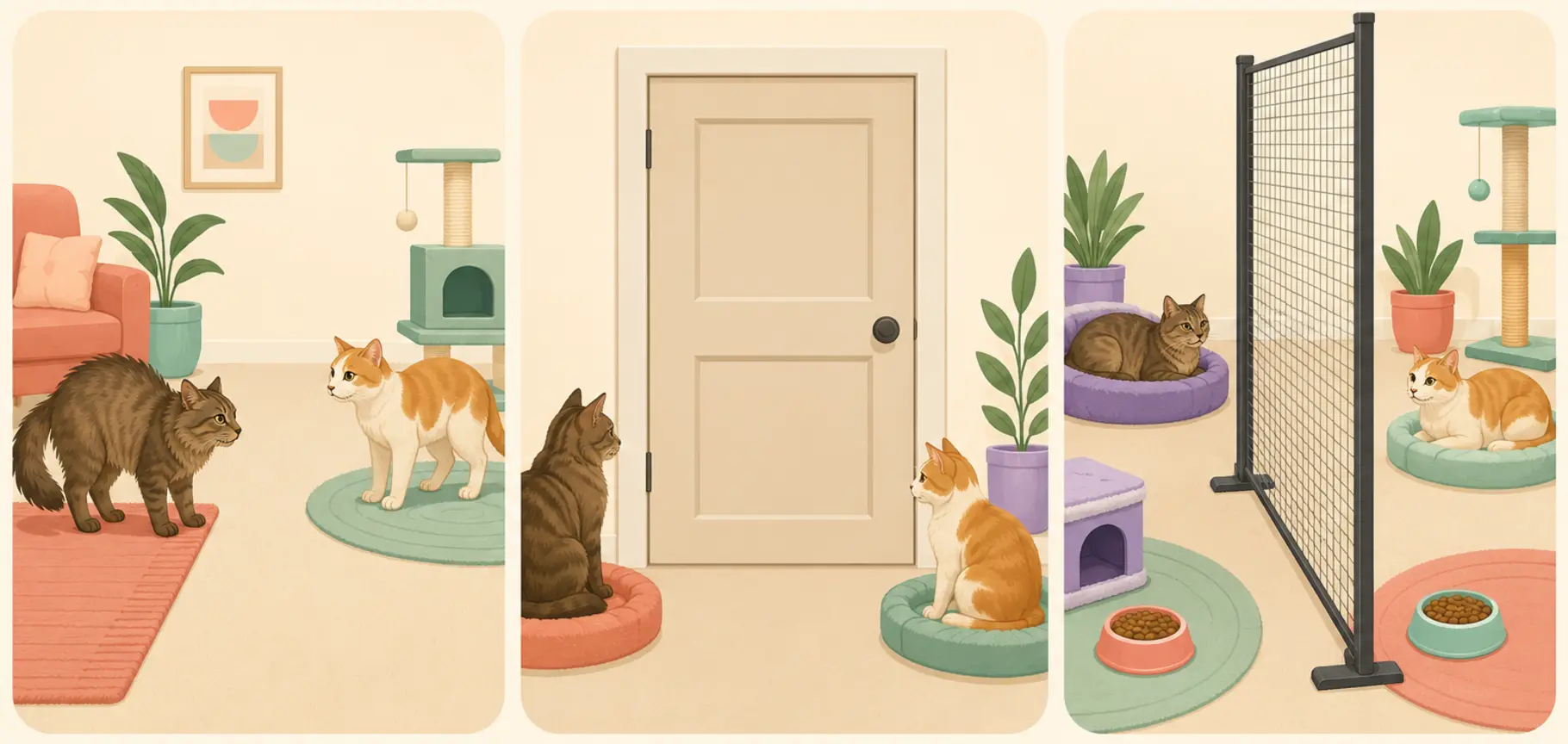
- 1Create safe distance
Use a door, large object or other barrier to separate the cats without placing hands or feet between them.
- 2Check health and triggers
Give each cat complete resources in a separate room and arrange veterinary advice when aggression is sudden, severe or paired with pain signs.
- 3Restart at a secure barrier
Reintroduce scent and brief visual contact only after both cats are calm, keeping food, litter, rest and escape routes separate.
Why a relationship can change quickly
A frightening sound, outdoor cat, clinic visit, illness, pain or blocked route can produce high arousal or make a familiar cat smell and move differently. The apparent target may not be the original trigger, especially with redirected aggression.
Separate without using your hands
Do not reach between fighting cats. Use a solid barrier, large object or door from a safe distance and give each cat a complete room with food, water, litter, hiding and rest. Allow arousal to fall fully before any visual contact.
Check injuries and health
Look for punctures, limping, pain, appetite change and difficulty moving without forcing handling. Bite wounds can seal over and form abscesses. Both cats should be assessed when aggression is sudden, even if only one appears unwell.
Reintroduce in small stages
Begin with complete separation and calm routines, then exchange bedding or room access without direct meetings. Progress to controlled visual contact and positive activities only while both cats remain relaxed. Return to an easier stage at tension.
Prevent another conflict
Distribute resources and routes, reduce stressful outdoor views and avoid forcing shared space. Seek qualified behaviour support for repeated incidents, ongoing fear or inability to progress. Collapse, severe injury or breathing difficulty is urgent.
Your quick checklist
Loading saved progress…
Three simple things you can do
You do not have to change everything today. Pick one step that feels realistic, try it and see how your cat responds.
- 1Observe your cat’s individual baseline.
- 2Make one gentle change at a time.
- 3Ask a qualified professional when health or safety is involved.
Common mistakes
×Waiting for a dramatic symptom instead of noticing smaller changes from the cat’s normal routine.
×Changing several things at once, making it difficult to learn what actually helped.
×Treating general guidance as a substitute for advice from a veterinarian who knows the individual cat.
Questions cat people ask
Does every cat follow the same rule?+
No. Age, health, history, temperament and environment all change what works for an individual.
When should I seek professional help?+
Seek veterinary advice for sudden, persistent or concerning changes and urgent help for breathing difficulty, collapse, seizures, poisoning or urinary obstruction signs.
Still looking for the right answer?
Search the full EverYes Cats encyclopedia with your own words — a symptom, food, behaviour, breed or everyday question.
Checked, dated and transparent
- Prepared by
- EverYes Cats editorial team
- Last updated
- Source checked
- Primary reference
- Cornell: Aggression in cats ↗
We begin with the named reference, rewrite the information in plain language and add practical cat-parent steps. Urgent health statements are checked against veterinary sources. This guide has not been individually reviewed by a veterinarian unless explicitly stated. It provides education, not diagnosis or treatment.
How we choose and use sources →
Spotted something unclear or outdated? Tell us so we can review it.
Loading your saved choice…
Mutual grooming can support familiarity and reach difficult areas, but it does not prove that two cats share every resource comfortably. Read consent, reciprocity and what happens before and after the grooming.
 01
 02
 03
 04
 05
 06