Why Does My Senior Cat Groom One Side Less?
A senior cat grooming one side less may be avoiding a painful or difficult movement. Compare both sides, help the coat gently and have a new asymmetric change assessed.
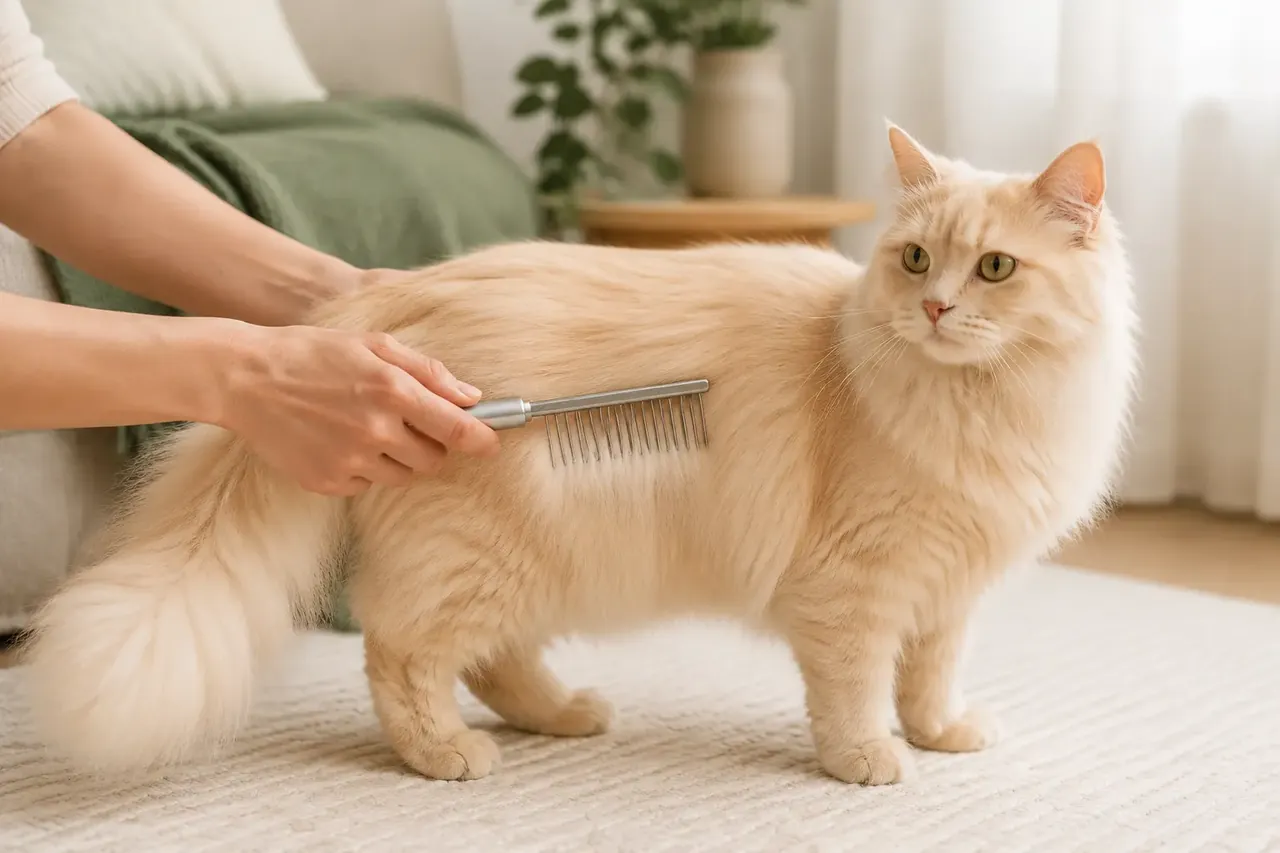 Topic illustration selected for this guide. Some learning images may be AI-assisted.
Why Does My Senior Cat Groom One Side Less — the quick answer
✓ Pain, stiffness, dental trouble or reduced flexibility can make one side harder to reach.
✓ Use brief gentle brushing and arrange a veterinary mobility and mouth check.
✓ Pain, skin wounds, rapid matting or sudden weakness needs prompt care.
Pain, stiffness, dental trouble or reduced flexibility can make one side harder to reach. Start by comparing the moment with your cat's usual pattern.
Map the asymmetry
Photograph and note where coat texture, grease, dandruff, loose hair or mats differ. Watch whether the cat turns the head and spine equally, bears weight evenly, lies on one side more, drops food or reacts to ordinary touch. Do not press repeatedly, stretch limbs or provoke grooming; the location and related movements are more useful than a home pain test.
Protect the neglected coat
On a warm non-slip surface, use fingertips and then a soft suitable tool for a few comfortable strokes. Support loose skin, avoid pulling and let the cat leave. Do not use scissors on tight mats or apply essential oils and fragranced detanglers. Ask a veterinary team or experienced cat groomer for safe mat removal when skin is hidden or handling hurts.
Look for a cause, not just a knot
One-sided grooming loss can accompany local joint or back pain, dental discomfort, skin disease, injury, weakness or neurologic change. New asymmetry deserves veterinary assessment even if the cat still eats and walks. Bring the coat map, natural-movement video and notes about jumping, litter use, appetite and chewing so the whole pattern can be considered.
Escalate sudden or severe signs
Prompt care is needed for open or infected skin, marked pain, rapid matting, appetite loss or worsening weakness. Sudden inability to stand, dragging a limb, a major fall, collapse or breathing difficulty is urgent. Keep the cat safely contained and avoid manipulating the painful side while contacting a clinic.
Your quick checklist
Loading saved progress…
Three simple things you can do
You do not have to change everything today. Pick one step that feels realistic, try it and see how your cat responds.
- 1Observe your cat’s individual baseline.
- 2Make one gentle change at a time.
- 3Ask a qualified professional when health or safety is involved.
Common mistakes
×Waiting for a dramatic symptom instead of noticing smaller changes from the cat’s normal routine.
×Changing several things at once, making it difficult to learn what actually helped.
×Treating general guidance as a substitute for advice from a veterinarian who knows the individual cat.
Questions cat people ask
Does every cat follow the same rule?+
No. Age, health, history, temperament and environment all change what works for an individual.
When should I seek professional help?+
Seek veterinary advice for sudden, persistent or concerning changes and urgent help for breathing difficulty, collapse, seizures, poisoning or urinary obstruction signs.
Still looking for the right answer?
Search the full EverYes Cats encyclopedia with your own words — a symptom, food, behaviour, breed or everyday question.
Checked, dated and transparent
- Prepared by
- EverYes Cats editorial team
- Last updated
- Source checked
- Primary reference
- Cornell Feline Health Center: Is Your Cat Slowing Down? ↗
We begin with the named reference, rewrite the information in plain language and add practical cat-parent steps. Urgent health statements are checked against veterinary sources. This guide has not been individually reviewed by a veterinarian unless explicitly stated. It provides education, not diagnosis or treatment.
How we choose and use sources →
Spotted something unclear or outdated? Tell us so we can review it.
Loading your saved choice…
A senior cat may stare at a wall because of a faint sound, light or scent, but new fixed staring can also accompany vision, hearing, neurological or cognitive change. Record the whole episode and arrange assessment for a new pattern.
 01
 03
 05