How cats recognize their favorite person
Cats often prefer the person who feels safest and most predictable—not simply the person who fills the bowl. Voice, scent, respectful handling and repeated positive routines all shape the bond.
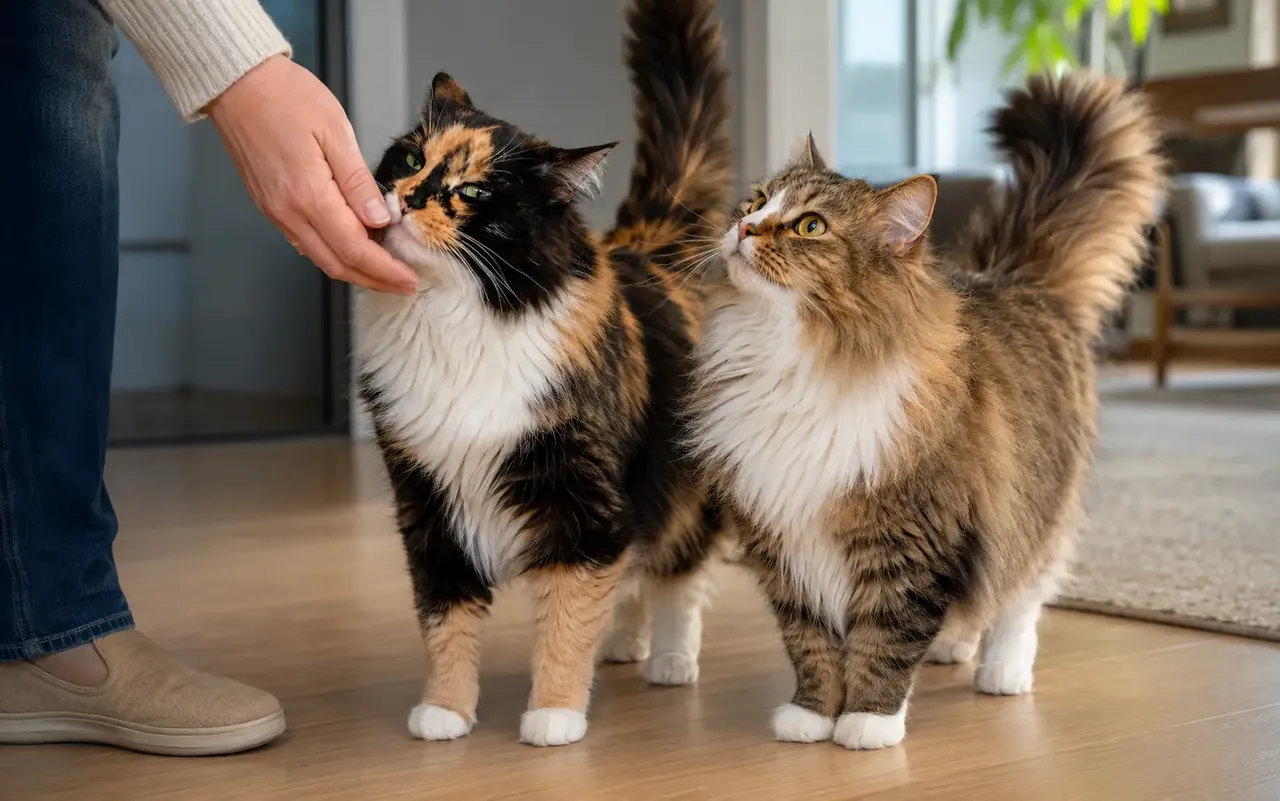 Topic illustration selected for this guide. Some learning images may be AI-assisted.
How cats recognize their favorite person — the quick answer
✓ Cats learn familiar voices and movement patterns
✓ Scent is central to recognition
✓ Trust grows from choice and predictability
Your cat experiences you through a rich combination of scent, sound, movement and memory. Recognition is far more than seeing your face.
A familiar sound map
Cats can learn the rhythm of footsteps, the sound of a particular car or the pattern of a person's voice. These small cues predict what happens next.
Your scent is information
Cats use scent to understand individuals and shared territory. Rubbing against you can mix familiar scents and support social familiarity.
Favorite does not always mean cuddliest
Some cats show attachment by sitting nearby, following at a distance or greeting you at the door. Respecting boundaries often strengthens the relationship.
Notice the quiet signs of preference
Following you between rooms, resting nearby, greeting you with an upright tail, slow blinking and choosing your lap are possible signs of trust. Some cats prefer close proximity without touch, so compare the cat’s voluntary choices rather than using cuddling as the only measure.
Become easier to trust
Keep greetings calm, pause during petting, provide play the cat can catch and let the cat leave without being followed. Share pleasant routines across the household so one relationship can grow without making the cat dependent on a single person.
Your quick checklist
Your progress is saved on this device.
Three simple things you can do
You do not have to change everything today. Pick one step that feels realistic, try it and see how your cat responds.
- 1Create one predictable daily ritual such as play or quiet sofa time.
- 2Let the cat end contact without following or restraining them.
- 3Notice less obvious affection such as sitting nearby or greeting you.
Common mistakes
×Interpreting one movement without reading the ears, eyes, posture and situation together.
×Forcing interaction when the cat is asking for distance or time to observe.
×Using punishment, which can increase fear without teaching a safer alternative.
Questions cat people ask
Can a cat have more than one favorite person?+
Yes. A cat may seek different people for play, food, rest or security and can form strong relationships with several people.
Why does my cat prefer someone who ignores them?+
That person may feel predictable and low-pressure. Allowing choice can be more inviting than repeated attempts to touch or hold.
Still looking for the right answer?
Search the full EverYes Cats encyclopedia with your own words — a symptom, food, behaviour, breed or everyday question.
Checked, dated and transparent
- Prepared by
- EverYes Cats editorial team
- Last updated
- 13 August 2026
- Source checked
- 13 August 2026
- Primary reference
- FelineVMA Healthy Feline Environment ↗
We begin with the named reference, rewrite the information in plain language and add practical cat-parent steps. Urgent health statements are checked against veterinary sources. This guide has not been individually reviewed by a veterinarian unless explicitly stated. It provides education, not diagnosis or treatment.
Spotted something unclear or outdated? Tell us so we can review it.
Your answer helps us improve the cat encyclopedia.
Cats need different nutrition, preventive care, home access and monitoring as they move from kittenhood through adulthood and the senior years. Age guides care, but the individual cat sets the pace.