Why cats chatter at birds
Cats often chatter when intensely watching birds or other prey through a secure window. It usually reflects hunting focus and arousal, not frustration that needs punishment or outdoor access.
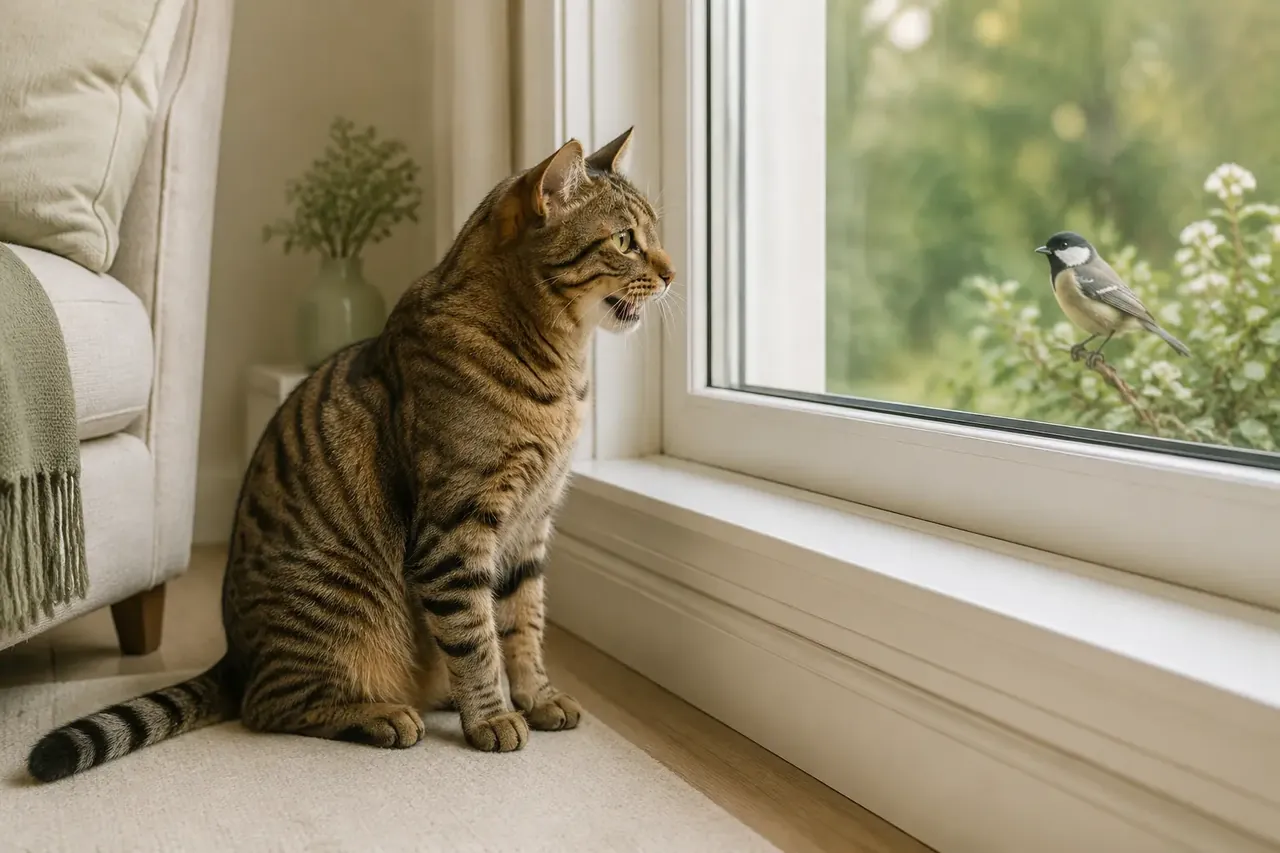 Topic illustration selected for this guide. Some learning images may be AI-assisted.
Why cats chatter at birds — the quick answer
✓ Chattering commonly appears during hunting focus
✓ A secure window view can be enriching
✓ Never allow access through an unsecured window
A bird lands outside the window and your cat makes a quick clicking sound. Chattering often appears during intense visual focus on prey that is safely out of reach.
A high-focus moment
Forward attention, stillness and a moving tail tip often show an absorbed hunter rather than distress.
Make the view safe
A stable perch beside a securely closed or screened window can turn outdoor movement into daily enrichment.
Complete the hunt
Follow window watching with a short wand-toy session so your cat can stalk, chase and finally catch something appropriate.
Read the moment around the sound
Forward attention, a still crouch and moving tail tip often fit focused observation. Chattering that appears away from prey, with mouth pain, drooling, breathing changes or unusual jaw movement needs veterinary assessment instead of a behavioural explanation.
Turn watching into a safe hunt cycle
Provide a stable perch behind a securely closed window or animal-safe screen. Follow some watching sessions with a wand toy that hides, darts, can be caught and ends with a small measured food reward. Do not allow unsupervised access to string toys.
Your quick checklist
Your progress is saved on this device.
Three simple things you can do
You do not have to change everything today. Pick one step that feels realistic, try it and see how your cat responds.
- 1Provide a stable perch at a securely closed or properly screened window.
- 2Observe whether the cat remains focused and relaxed rather than distressed.
- 3Follow window watching with a short wand-toy hunt that ends in a catch.
Common mistakes
×Opening or leaving a window unsecured so the cat can reach prey.
×Assuming every jaw movement is harmless chattering despite drooling, pain or eating difficulty.
×Frustrating the cat with endless visual prey and no appropriate hunting outlet.
Questions cat people ask
Why does my cat chatter when watching birds?+
Chattering commonly appears during intense hunting focus and excitement when prey is visible but unreachable. The exact mechanism is not fully settled.
Is cat chattering a sign of dental pain?+
Context matters. Brief chatter at birds can be normal, but jaw movement with drooling, bad breath, appetite change, pawing at the mouth or pain needs veterinary assessment.
Still looking for the right answer?
Search the full EverYes Cats encyclopedia with your own words — a symptom, food, behaviour, breed or everyday question.
Checked, dated and transparent
- Prepared by
- EverYes Cats editorial team
- Last updated
- 13 August 2026
- Source checked
- 13 August 2026
- Primary reference
- FelineVMA Healthy Feline Environment ↗
We begin with the named reference, rewrite the information in plain language and add practical cat-parent steps. Urgent health statements are checked against veterinary sources. This guide has not been individually reviewed by a veterinarian unless explicitly stated. It provides education, not diagnosis or treatment.
Spotted something unclear or outdated? Tell us so we can review it.
Your answer helps us improve the cat encyclopedia.
Brief cat zoomies are usually normal bursts of sprinting after rest, play or litter-box use. Make the route safe and use daily hunt-style play; investigate episodes that include distress, pain or disorientation.