Raw diets for cats: benefits claimed, risks known
An evidence-aware guide to pathogens, bones and nutritional balance.
 Topic illustration selected for this guide. Some learning images may be AI-assisted.
Raw diets for cats: benefits claimed, risks known — the quick answer
✓ Raw food can carry harmful bacteria
✓ Bones can injure or obstruct
✓ Homemade does not automatically mean complete
✓ Discuss goals with a veterinary nutrition professional
Raw feeding is often promoted as natural, but raw meat can carry pathogens that affect cats and people, and homemade recipes may be nutritionally incomplete. This is especially important in homes with children, older adults or immunocompromised people.
Assess the whole raw-food risk before changing diet
Raw animal products can expose cats and people to pathogens, while an improvised recipe may also be nutritionally incomplete.
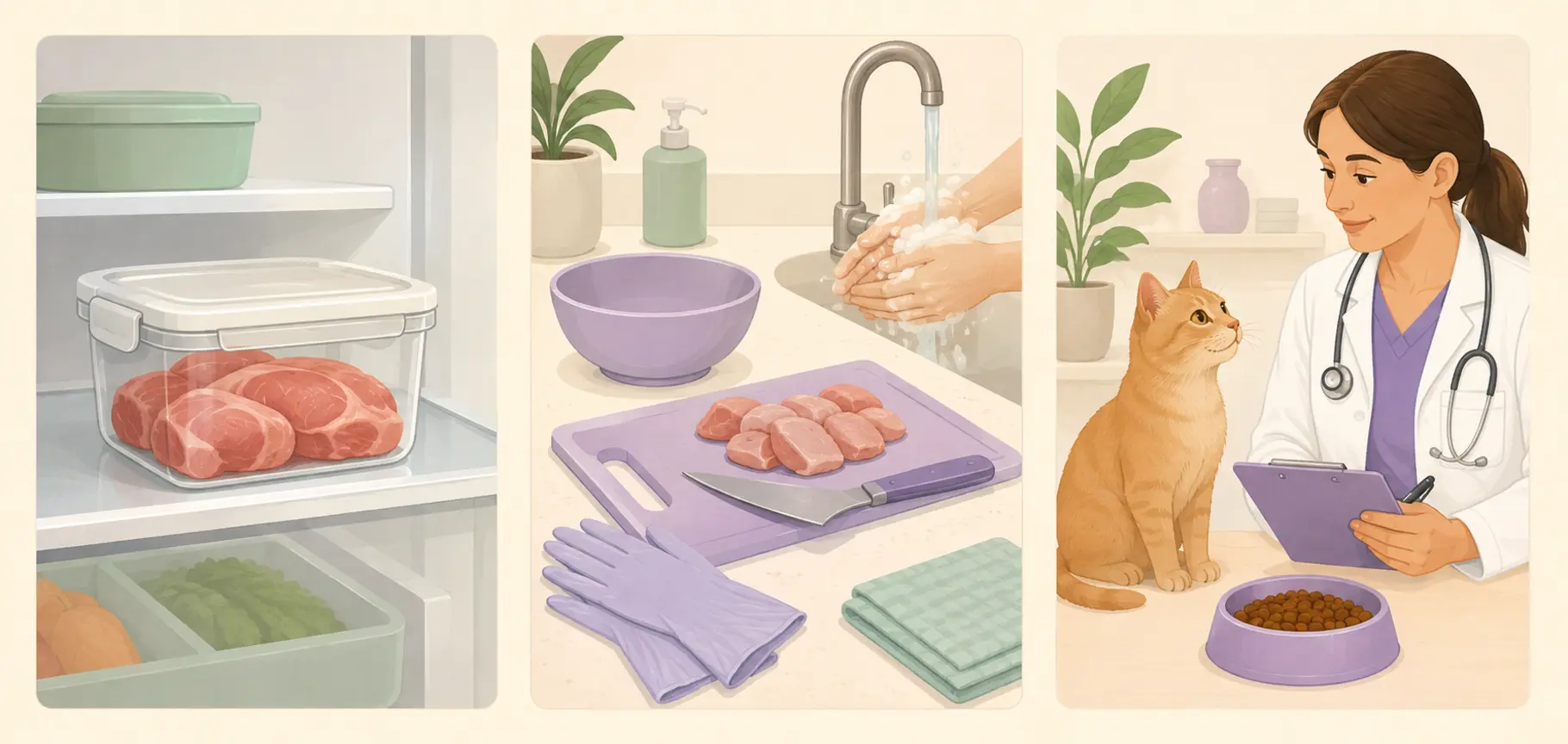
- 1Start with veterinary advice
Discuss your cat's age, health, household vulnerability and current complete diet before making a major feeding change.
- 2Prevent cross-contamination
Keep raw products sealed and cold, separate equipment from human food preparation and clean hands, bowls and surfaces thoroughly.
- 3Choose a complete plan
Prefer a complete balanced food or use a recipe formulated for your individual cat by a qualified veterinary nutrition professional.
Separate claims from outcomes
Anecdotes about coat, stool or enthusiasm do not establish that a diet is safer or nutritionally superior. Ask what evidence supports the specific product and outcome.
Understand household exposure
Pathogens may spread through bowls, preparation surfaces, saliva and feces even when the cat looks healthy. Freezing does not reliably remove every hazard.
Balance is a formulation problem
Cats need precise amounts and ratios of amino acids, fatty acids, vitamins and minerals. Meat alone is not a complete feline diet, and internet recipes vary widely.
Choose a safer next step
Explain the result you want—palatability, fewer ingredients or a different texture—to your veterinarian. A complete cooked commercial diet or a recipe formulated by a board-certified veterinary nutritionist may address it more safely.
Your quick checklist
Your progress is saved on this device.
Three simple things you can do
You do not have to change everything today. Pick one step that feels realistic, try it and see how your cat responds.
- 1Discuss any raw diet with a veterinarian or qualified veterinary nutritionist before feeding.
- 2Protect children, older adults and vulnerable people from contaminated bowls, surfaces and faeces.
- 3Use a complete commercial alternative when food-safety or nutritional balance cannot be assured.
Common mistakes
×Assuming freezing reliably removes every pathogen.
×Using raw meat alone as a complete balanced diet.
×Ignoring cross-contamination of hands, bowls, floors and litter areas.
Questions cat people ask
Is raw food naturally better for cats?+
Natural does not automatically mean safer or nutritionally complete. Raw diets can carry bacterial and parasite risks and may be unbalanced without expert formulation.
Can freezing make raw cat food safe?+
Freezing may reduce some parasites but does not reliably eliminate all bacteria or every hazard. Safe handling and nutritional adequacy still matter.
Still looking for the right answer?
Search the full EverYes Cats encyclopedia with your own words — a symptom, food, behaviour, breed or everyday question.
Checked, dated and transparent
- Prepared by
- EverYes Cats editorial team
- Last updated
- 7 August 2026
- Source checked
- 7 August 2026
- Primary reference
- US Food and Drug Administration ↗
We begin with the named reference, rewrite the information in plain language and add practical cat-parent steps. Urgent health statements are checked against veterinary sources. This guide has not been individually reviewed by a veterinarian unless explicitly stated. It provides education, not diagnosis or treatment.
Spotted something unclear or outdated? Tell us so we can review it.
Your answer helps us improve the cat encyclopedia.
A tiny piece of plain cheese is not usually toxic, but many cats digest dairy poorly and cheese adds salt and calories without being needed.