Teach “off” without frightening your cat
Rewarding an available floor or perch is clearer than spraying or shouting. A calm, practical guide to what it means and what to do next.
 Topic illustration selected for this guide. Some learning images may be AI-assisted.
Teach “off” without frightening your cat — the quick answer
✓ Rewarding an available floor or perch is clearer than spraying or shouting
✓ Provide a nearby legal perch, cue movement away and reward the alternative consistently.
✓ Keep hot pans, knives and toxic foods inaccessible regardless of training.
Rewarding an available floor or perch is clearer than spraying or shouting. Counters offer height, food smells and attention, so a replacement must meet some of those needs. This guide separates the useful observation from guesswork and gives you one safe next step.
Make the safe alternative worth choosing
Counters provide height and information, so training works better when another useful perch is close by.
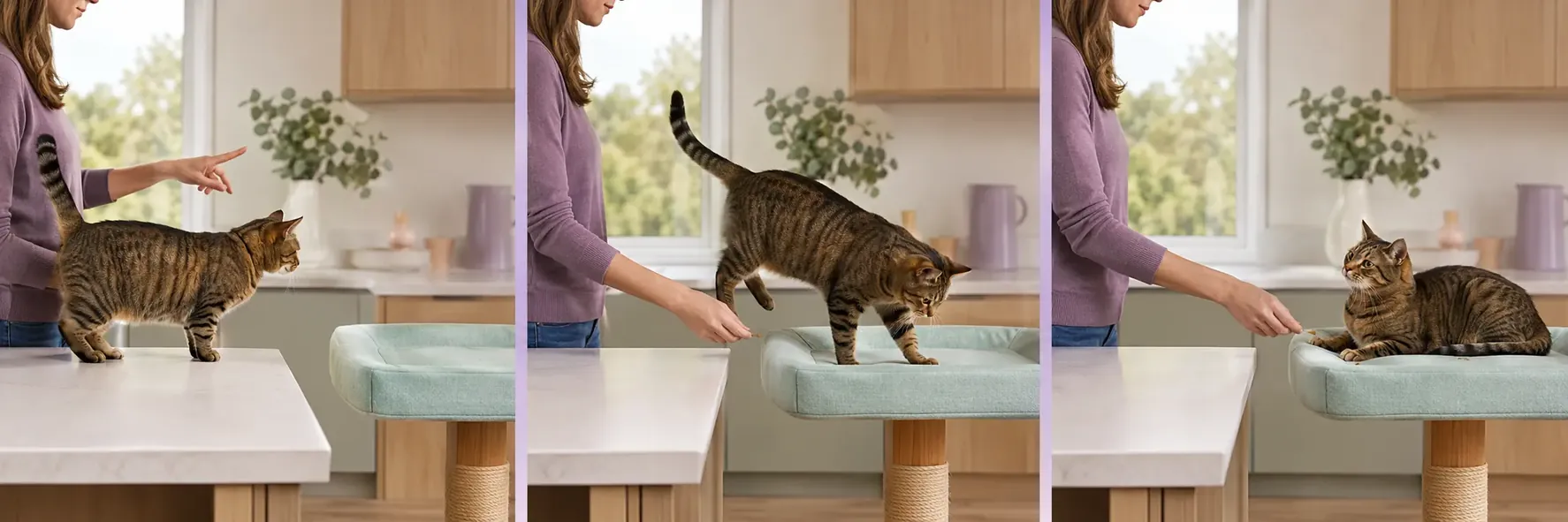
- 1Clear hazards first
Keep heat, knives and unsafe food inaccessible, then position a broad stable legal perch within an easy short move.
- 2Cue the alternative
Calmly guide attention toward the perch without touching the cat and reward as soon as they choose it.
- 3Reward staying there
Continue rewarding relaxed use of the legal perch while keeping the counter consistent, safe and unrewarding.
The clear answer
Rewarding an available floor or perch is clearer than spraying or shouting. Counters offer height, food smells and attention, so a replacement must meet some of those needs.
What to observe in your own cat
Read posture, muscle tension, eyes, ears, whiskers, tail, distance and the cat's ability to leave. Rewarding an available floor or perch is clearer than spraying or shouting. One signal without its setting is easy to misread.
Why two cats may look different
Age, health, body shape, early experience, confidence and the immediate environment all affect what owners see. A common pattern can still deserve attention when it is new or different for this individual cat.
Make the home support the answer
Protect food, water, litter, rest, hiding and a clear route away while testing one small adjustment. Stable essentials make the cat's response easier to interpret.
A practical next step
Provide a nearby legal perch, cue movement away and reward the alternative consistently. Keep the change small and easy to reverse, then compare the same facts again rather than relying on memory.
What not to do
Do not punish, frighten, force handling or remove every familiar option at once. Avoid using a general explanation to dismiss a sudden change in health or behaviour.
Warning signs and veterinary help
Keep hot pans, knives and toxic foods inaccessible regardless of training.
Source and limits
This educational guide is informed by International Cat Care. It can help you observe and prepare useful information, but it cannot examine your cat, diagnose a condition or replace individual veterinary advice.
Your quick checklist
Your progress is saved on this device.
Three simple things you can do
You do not have to change everything today. Pick one step that feels realistic, try it and see how your cat responds.
- 1Provide a nearby legal perch with an equally useful view.
- 2Reward the perch before food preparation begins.
- 3Remove food residue and calmly redirect without chasing.
Common mistakes
×Using spray bottles or startling devices.
×Leaving food out between punishments.
×Expecting floor-level furniture to replace an attractive high counter.
Questions cat people ask
Can I train my cat to stay off kitchen counters?+
You can reduce the behaviour through management and a well-rewarded alternative, but unsupervised reliability depends on removing food and other rewards.
Why does punishment fail when I leave?+
The cat learns that the consequence depends on your presence, while height, scent and food continue to reward the counter itself.
Still looking for the right answer?
Search the full EverYes Cats encyclopedia with your own words — a symptom, food, behaviour, breed or everyday question.
Checked, dated and transparent
- Prepared by
- EverYes Cats editorial team
- Last updated
- 9 August 2026
- Source checked
- 9 August 2026
- Primary reference
- International Cat Care ↗
We begin with the named reference, rewrite the information in plain language and add practical cat-parent steps. Urgent health statements are checked against veterinary sources. This guide has not been individually reviewed by a veterinarian unless explicitly stated. It provides education, not diagnosis or treatment.
Spotted something unclear or outdated? Tell us so we can review it.
Your answer helps us improve the cat encyclopedia.
Remaining hidden after visitors leave can be a normal recovery response. The useful measure is whether the cat gradually resumes eating, toileting and ordinary activity.