Moving day safety for cats
On moving day, keep the cat in one locked, labelled safe room or secure off-site location until doors are closed and the new base room is ready.
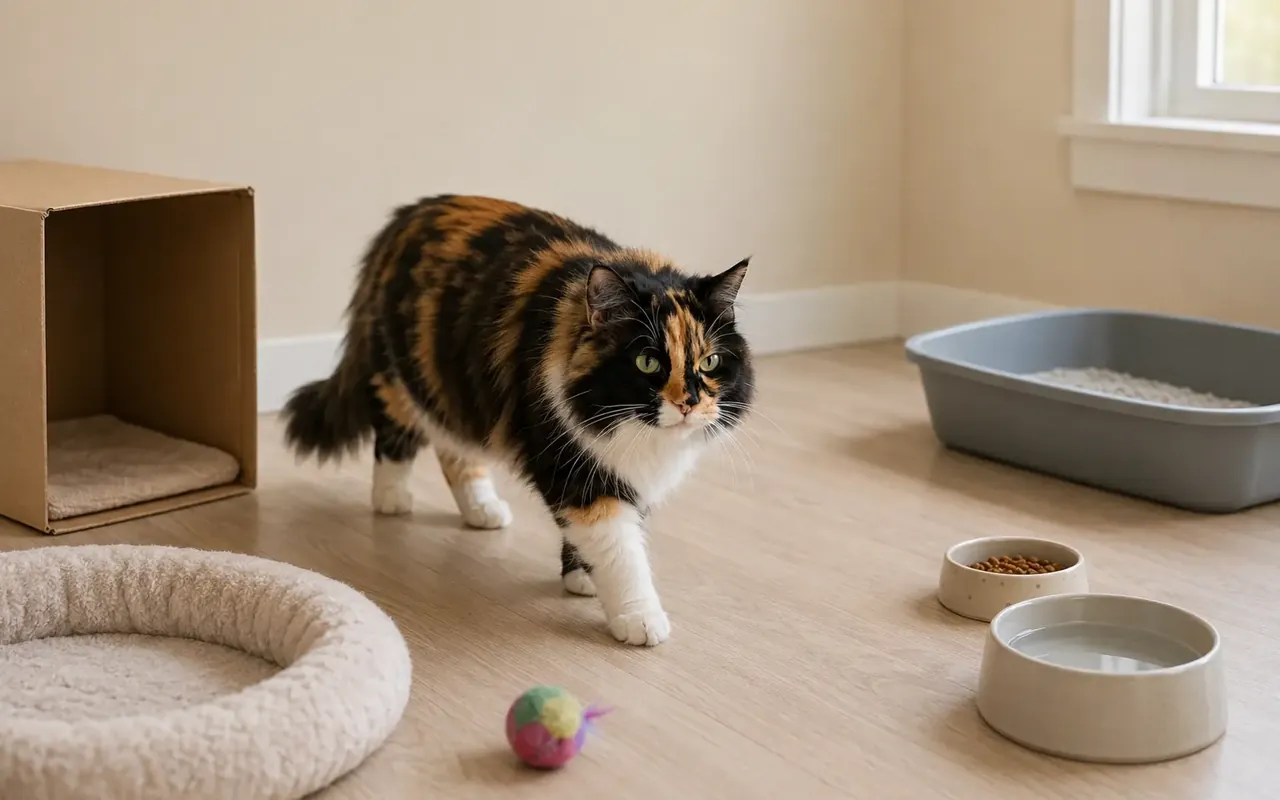 Topic illustration selected for this guide. Some learning images may be AI-assisted.
Moving day safety for cats — the quick answer
✓ Open doors, unfamiliar workers and shifting furniture create high escape and injury risk.
✓ Confine the cat in a labelled secure room or trusted boarding arrangement, then transport in a secured carrier.
✓ Update microchip details and contact local services promptly if a cat escapes.
Moving day temporarily removes the scent map and predictable boundaries that help a cat orient.
The short answer
Moving day temporarily removes the scent map and predictable boundaries that help a cat orient.
Why it may happen
Open doors, unfamiliar workers and shifting furniture create high escape and injury risk.
Read the whole situation
One behaviour rarely has one guaranteed meaning. Compare it with your cat’s age, health, posture, appetite, litter habits, environment and usual pattern before drawing a conclusion.
What to do now
Confine the cat in a labelled secure room or trusted boarding arrangement, then transport in a secured carrier.
What not to do
Avoid punishment, forced handling and sudden large changes. They can add fear while hiding the information that would help you understand the original cause.
When to contact a veterinarian
Update microchip details and contact local services promptly if a cat escapes.
Keep a useful record
Write down when it started, how often it happens and what immediately precedes and follows it. Photos, weights or short videos can make a veterinary or behaviour consultation more productive.
What to check first
The highest risks are escape, hiding inside packed furniture and being moved before essential resources are prepared. Count and visually confirm the cat before every door transition.
DEEPER GUIDE1 more detailed sectionsOpen +
What to do next
Set up carrier, litter, water, food, bedding and identification in advance. Move the cat last, open the carrier only inside the closed new base room and expand territory gradually. Escape, breathing trouble, injury, toxin exposure or refusal to eat after the move needs prompt local professional help.
Your quick checklist
Your progress is saved on this device.
Three simple things you can do
You do not have to change everything today. Pick one step that feels realistic, try it and see how your cat responds.
- 1Confine the cat in a locked labelled room while doors are open.
- 2Move the cat in a secure carrier after the new safe room is ready.
- 3Update microchip and contact details before moving.
Common mistakes
×Letting the cat follow movers.
×Opening the carrier outside.
×Giving immediate access to every new room.
Questions cat people ask
How do I stop my cat escaping on moving day?+
Use physical separation, a locked door and a secure carrier. A note alone is not enough when many people enter.
When can my cat go outside after moving?+
Wait until the cat is settled and location records are updated, then follow local veterinary guidance and use a gradual secure transition.
Still looking for the right answer?
Search the full EverYes Cats encyclopedia with your own words — a symptom, food, behaviour, breed or everyday question.
Checked, dated and transparent
- Prepared by
- EverYes Cats editorial team
- Last updated
- 14 August 2026
- Source checked
- 14 August 2026
- Primary reference
- Cats Protection ↗
We begin with the named reference, rewrite the information in plain language and add practical cat-parent steps. Urgent health statements are checked against veterinary sources. This guide has not been individually reviewed by a veterinarian unless explicitly stated. It provides education, not diagnosis or treatment.
Spotted something unclear or outdated? Tell us so we can review it.
Your answer helps us improve the cat encyclopedia.
A top-opening carrier can reduce struggling because the cat can be lowered in and examined with less pulling, provided every latch is strong and secure.