Why does one cat scratch immediately after another?
A second cat may scratch after the first because fresh scent and marks make the location socially relevant. Sequence alone does not prove dominance; access, posture and recovery show whether pressure is present.
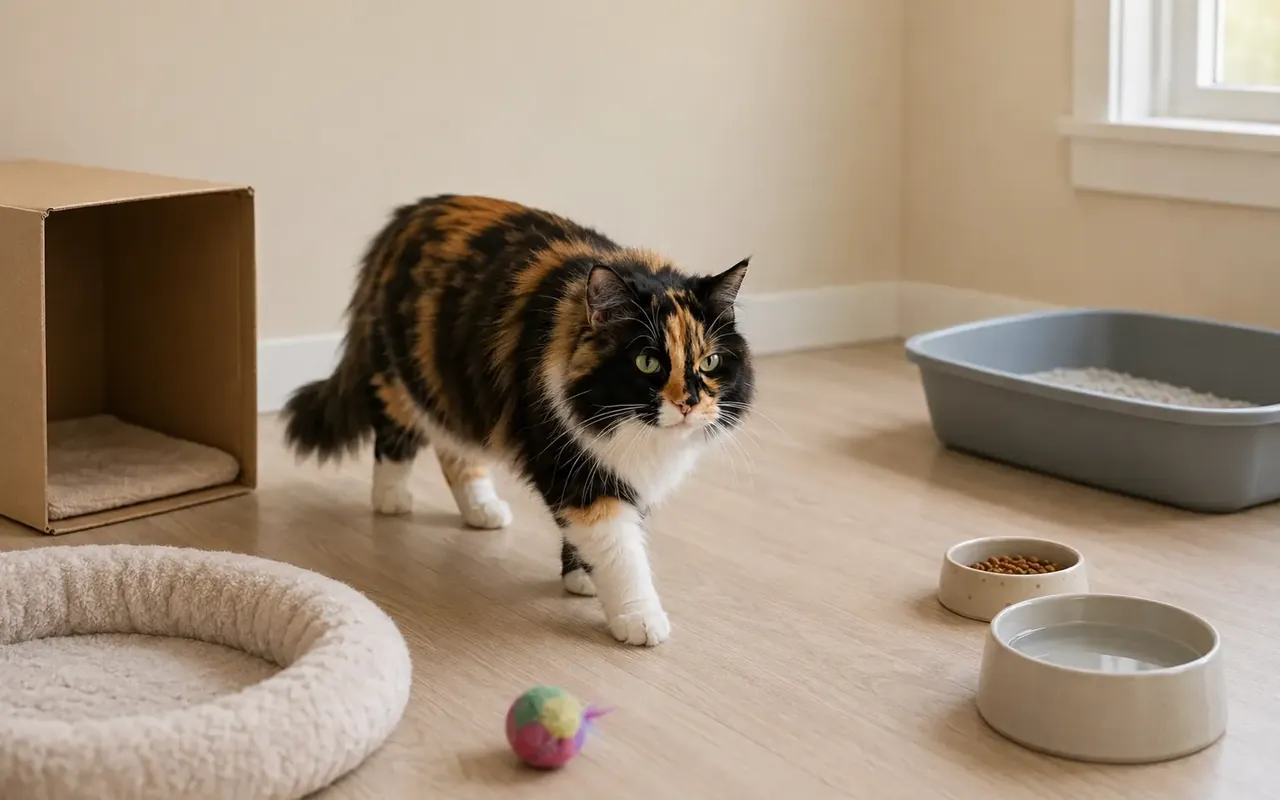 Topic illustration selected for this guide. Some learning images may be AI-assisted.
Why does one cat scratch immediately after another — the quick answer
✓ Fresh scent and visible marks can invite investigation or overmarking without proving conflict.
✓ Observe: Watch spacing, waiting, body tension and access to other scratchers.
✓ Try this: Offer several sturdy scratchers in socially important locations.
Fresh scent and visible marks can invite investigation or overmarking without proving conflict. The useful question is not only what the moment resembles, but whether it fits this cat’s normal pattern. Context, frequency, recovery and accompanying changes make the interpretation safer and more accurate.
Watch the full sequence
Record which cat approaches, whether either waits, stares or blocks, and whether roles sometimes reverse. Relaxed use with easy departure differs from one cat repeatedly driving the other away.
Provide several valued options
Place sturdy vertical and horizontal scratchers near sleeping areas, routes and room entrances. Separate them enough that one cat cannot supervise every option from a single position.
Preserve familiar scent safely
Do not wash or replace all scratchers at once. Repair unstable posts and replace damaged material gradually while leaving an accepted option available. Avoid fragrance and deterrent sprays.
When tension needs help
New avoidance, urine marking, hiding, wounds or escalating pursuit deserves veterinary and qualified behaviour assessment. Separate conflict safely with distance or a barrier, never hands.
Your quick checklist
Loading saved progress…
Three simple things you can do
You do not have to change everything today. Pick one step that feels realistic, try it and see how your cat responds.
- 1Observe your cat’s individual baseline.
- 2Make one gentle change at a time.
- 3Ask a qualified professional when health or safety is involved.
Common mistakes
×Waiting for a dramatic symptom instead of noticing smaller changes from the cat’s normal routine.
×Changing several things at once, making it difficult to learn what actually helped.
×Treating general guidance as a substitute for advice from a veterinarian who knows the individual cat.
Questions cat people ask
Does every cat follow the same rule?+
No. Age, health, history, temperament and environment all change what works for an individual.
When should I seek professional help?+
Seek veterinary advice for sudden, persistent or concerning changes and urgent help for breathing difficulty, collapse, seizures, poisoning or urinary obstruction signs.
Still looking for the right answer?
Search the full EverYes Cats encyclopedia with your own words — a symptom, food, behaviour, breed or everyday question.
Checked, dated and transparent
- Prepared by
- EverYes Cats editorial team
- Last updated
- Source checked
- Primary reference
- FelineVMA: Environmental Needs Guidelines ↗
We begin with the named reference, rewrite the information in plain language and add practical cat-parent steps. Urgent health statements are checked against veterinary sources. This guide has not been individually reviewed by a veterinarian unless explicitly stated. It provides education, not diagnosis or treatment.
How we choose and use sources →
Spotted something unclear or outdated? Tell us so we can review it.
Loading your saved choice…
A frightening first meeting does not prove two cats can never coexist. Separate them completely, restore normal eating and resting, then rebuild from scent to sight and shared space only while both cats remain relaxed and able to disengage.
 01
 03
 04